Your monthly report arrives and the traffic line points down. Fewer visits than last year, and fewer than the year before. It looks like your website is failing.
It may not be. Zero-click search has changed how people reach you, and visits are no longer a reliable stand-in for business. Before you cut the budget or plan a redesign, check what those lost visits were worth.
This post explains what zero-click search is, what new industry data says about traffic and leads, how to check your own numbers, and when a drop is a real problem. It's written for business owners and marketing leads who read the reports but don't work in them every day.
What zero-click search means for your website
A zero-click search is a search that ends on the results page. The person gets an answer from Google's AI Overviews, a featured snippet, a map listing, or an AI assistant, and never visits a website.
Quick factual questions are the first to go: definitions, opening hours, rough price ranges, general how-to topics. Those searches used to produce visits. Many of them no longer do.
The people who still click through usually have a stronger reason to. They want to compare providers, check prices, read the details, or get in touch. You get fewer visitors, but more of them are now closer to a decision.
What the State of Search 2027 data shows
For its State of Search 2027 report, Search Engine Journal asked search professionals how the past 12 months went for their organizations. Here is what they reported:
- 40% saw their organic search performance decline, while 29% saw meaningful improvement.
- 58% reported a negative impact from AI Overviews and zero-click search.
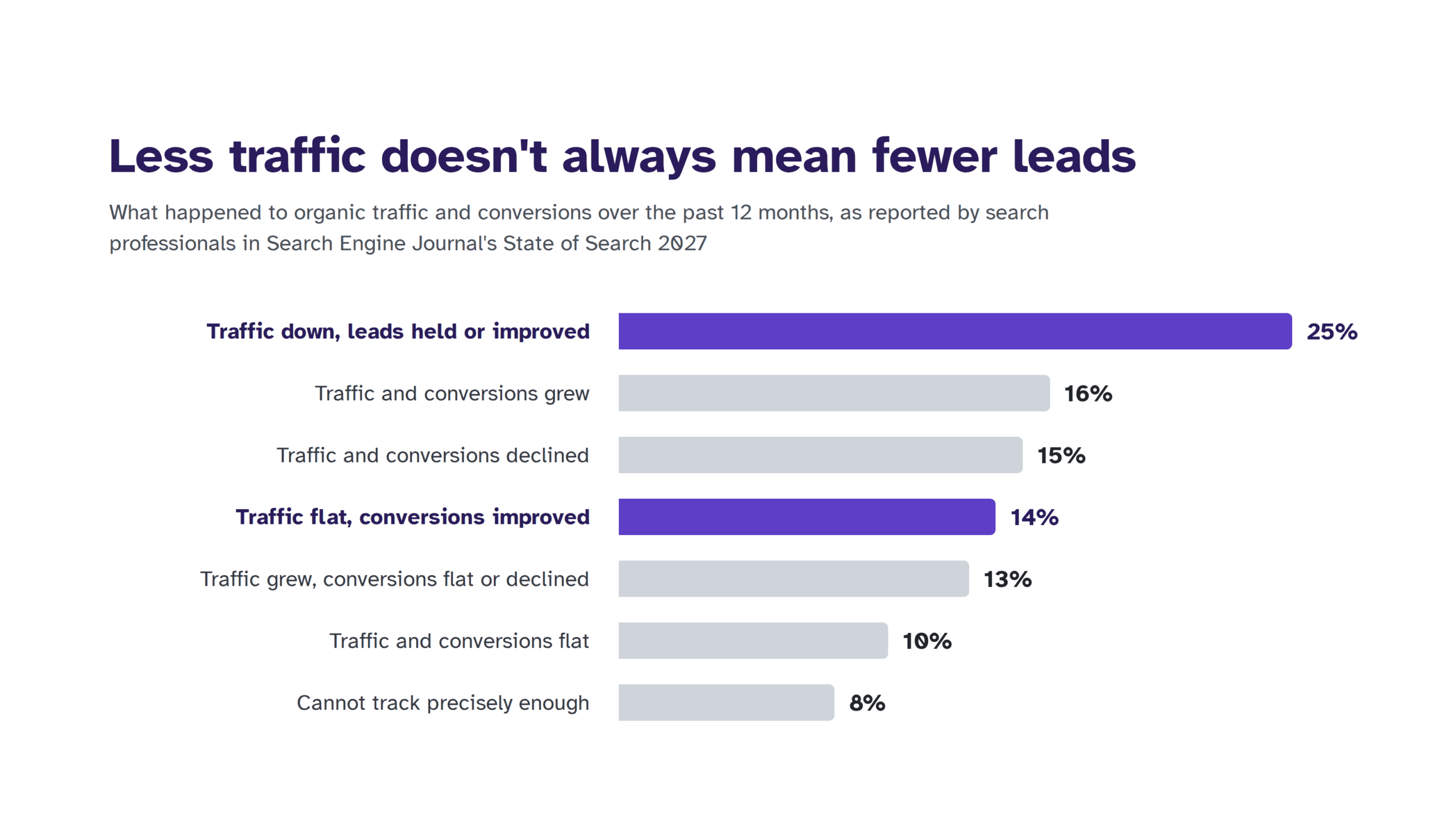
- 25% saw traffic fall while leads or conversions held or improved. Another 14% had flat traffic with improving conversions.
- Together, that's 39% who got equal or better business results from the same or fewer visits.
- Only 15% lost both traffic and conversions.
The likely explanation is that the visitors who remain are more likely to buy. AI answers satisfy casual searches before anyone clicks, and people with a real need still visit. Alex Moss, Principal SEO at Yoast, sums it up: the visitors who no longer arrive were probably not going to convert in the first place.
Helen Pollitt, Director of SEO at Getty Images, adds a point many people overlook: Traffic costs money. Hosting, analytics, and security costs grow with visitor numbers. If the visits you lost never produced inquiries, losing them may have saved you money.
How to check whether your organic traffic drop is a problem
Organic traffic still shows your reach. On its own, it can't tell you whether search is working for your business. These four checks can.
1. Compare traffic with leads over the same period
Put monthly organic traffic next to inquiries, calls, form submissions, bookings, or sales for the same 12 months. If traffic fell and leads held, your search visibility is probably doing its job with fewer, better visitors. If both fell together, see "When the numbers point to a real problem" further down.
2. Find the pages that still bring in business
Look at which landing pages, topics, and branded searches (people searching for your company name) lead to inquiries. Protect these first. They're the part of your website that works. Compare them with the pages that lost traffic, and you'll see which lost visits were worth little.
3. Check what the lost traffic was
Open Google Search Console and compare this year's queries with last year's. If most of the lost clicks came from informational questions, AI answers probably absorbed them. If you lost clicks on searches for your services, your location, or your brand name, that's a different problem.
4. Ask new clients how they found you
Add one question to your contact form or first call. AI assistants don't pass referral data the way search engines mostly do, so a client who found you through one may show up in your analytics as a direct visit. Asking fills that gap. Once a month, compare those answers with your marketing and sales numbers.
These checks give you a first answer. When a client comes to us with a traffic drop, we run a full audit to find out what happened, whether it matters, and how to fix it if it does. Some drops need action. Others only need a better way to read the numbers.
Why SEO ROI matters more than your traffic chart
The survey found a pattern worth your attention. Among respondents with reliable revenue attribution (they can trace sales back to search), 52% reported meaningful organic improvement. Among those with low confidence in their attribution, only 14% did.
The gap in actual business results was much smaller. Conversions held or grew for 68% of the first group and 49% of the second. In other words, many teams have search working for them and can't show it. That carries a risk: when budgets tighten, a program that can't demonstrate its value is often the first to go, even while it's still delivering.
Only 19% of respondents say their SEO attribution is reliable. That's why SEO ROI deserves a place in your regular reporting. You don't need an enterprise dashboard. A monthly view of qualified leads, where they came from, how many became clients, and what they were worth will tell you more than a traffic chart can. Our post on the 3 numbers business owners need to watch is a good place to start.
The mistake to avoid: cutting the foundations to chase AI search
The survey shows where attention is heading. Next year, 43% of respondents plan to prioritize optimization for AI answer engines, often called GEO (generative engine optimization). Only 14% named it among the activities that delivered their strongest results this year.
That attention has to come from somewhere. Technical SEO was credited with strong results by 37% of respondents but appears in only 24% of next year's plans. Content refreshes fall from 50% to 36%.
Harry Clarkson-Bennett, SEO Director at The Telegraph, calls losing focus on technical SEO an error in most cases. He names semantic HTML, JavaScript rendering, heading structure, and accessibility as the neglected foundations. The same crawlability, freshness, authority, and structure behind strong SEO are what help AI systems find, understand, and cite your content.
We agree, and it's how we build. An accessible, well-structured, fast website is easier for search engines and AI tools to read. Our post on AI search optimization covers what to add. Give AI visibility its own budget on top of the basics, not in place of them.
Make sure AI tools describe your business accurately
One gap in the data stands out for business owners. Only 16% of respondents try to appear in AI answers to the questions buyers ask right before they decide, the ones your pricing pages, service details, and case studies answer. Those are the pages a buyer checks right before contacting you.
AI tools fill gaps with whatever they can find, including outdated reviews and forum posts. If your pricing or services aren't clear on your own site, an AI answer may describe them wrongly at the moment someone is deciding.
In practice, that means:
- State what you offer, who it's for, and how you work in plain language on your service pages.
- Publish pricing or a clear price range where your business model allows it.
- Keep case studies and your Google Business Profile current.
- If you work in more than one language, check each version. A clear English page doesn't help a buyer searching in Greek or German.
When the numbers point to a real problem
Fewer, better visitors is a common pattern, not a guarantee. Take your numbers seriously if:
- Leads fell with traffic. That was the case for 15% of respondents. Start with why your Google ranking dropped and what to do about it.
- You lost clicks on searches for your services or brand name. Those are buyers, not browsers.
- Reach itself is your product. For publishers, and for brands that depend on awareness, a shrinking audience can reduce future demand even while conversion rates look healthy today.
- Traffic grew but leads didn't. That happened to 13% of respondents. The growth may come from people looking for a quick definition who land on pages with no clear next step.
The decision in one sentence
Judge your search visibility by the inquiries and revenue it produces, not by the size of the traffic line, and keep funding the foundations that make both possible.
If you want to see how search works beyond Google, read Search Everywhere Optimization: why your business needs visibility beyond Google. If you'd like to know what your own traffic drop means, our Search Everywhere Optimization service starts with that full audit.
Frequently asked questions
What is zero-click search?
A zero-click search ends on the results page without a visit to any website. The answer comes from an AI Overview, a featured snippet, a map listing, or an AI assistant. It mostly affects quick informational questions rather than searches from people ready to buy.
Is organic traffic still worth tracking?
Yes, as a measure of reach. Organic traffic shows how many people find you, and it matters most when awareness drives future demand. Read it alongside leads, conversions, and revenue rather than on its own.
How do I measure SEO ROI without an analytics team?
Start with the conversions you value most: calls, forms, bookings, or sales. Tag where each one came from, ask new clients how they found you, and compare the value of search leads with what you spend on SEO. A simple monthly spreadsheet is enough to show direction.
Should I stop publishing informational content because of zero-click search?
Not necessarily. Harry Clarkson-Bennett points out that evergreen content still plays a foundational role in winning and keeping an audience. Focus on content that answers your buyers' real questions, and update the pieces that still bring in leads.